AI business intelligence prototype
Prototyping an AI Intelligence Layer for Business Decision-Making
Alatus Signals
- Role
- Product Strategist & Prototype Builder
- Organization
- Alatus Solutions
- Timeline
- 2026
- Status
- Working prototype
Visuals
Shared with approval. Customer and internal business data redacted.
Context
- I built the Alatus Signal Platform, a working prototype made with Claude Code and Lovable that surfaces risks, wins, failures, opportunities, and insights for brand leaders. Two of the three targeted brand leaders began using it.
- Brand leaders need a quick read on what's going well, what's at risk, and where the opportunities are, without digging through reports.
What was needed
- I framed the problem around the decisions brand leaders make each week, not the data that happens to be available.
- Prototype first: test whether the signals are useful before investing in production-grade infrastructure.
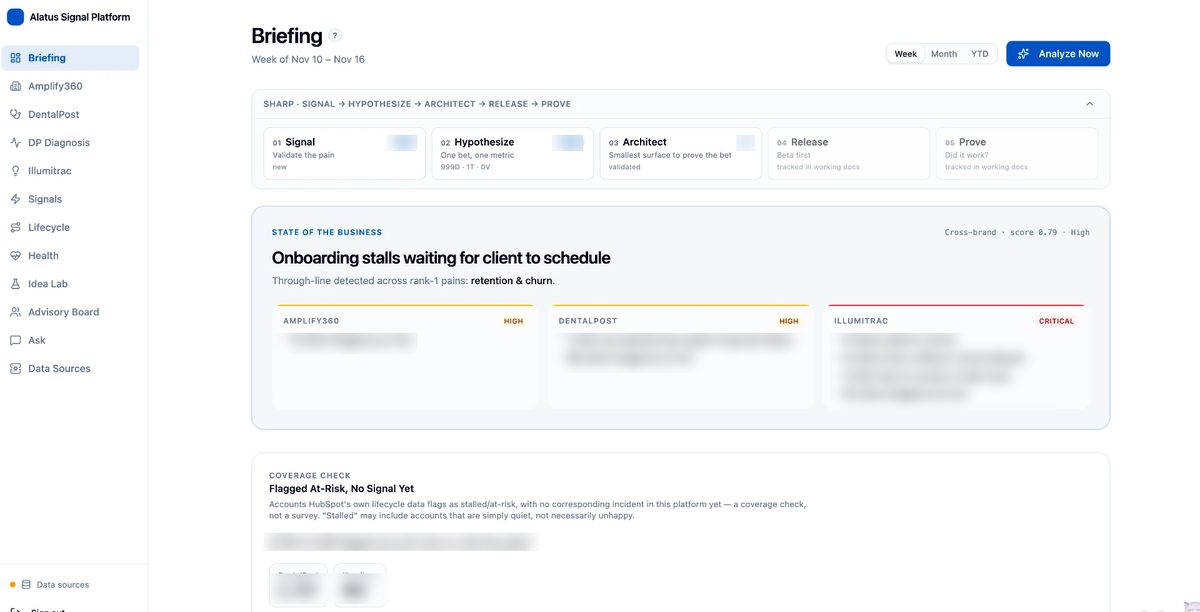
- I designed SHARP, a product-discovery framework built into the platform: Signal → Hypothesize → Architect → Release → Prove. Validate the pain, one bet one metric, smallest surface to prove the bet, beta first, did it work?
What I did
- Built personally: the working prototype, using Claude Code and Lovable.
- Owned: problem framing, experimentation, and the SHARP framework.
- A weekly Briefing (week, month, YTD) with a cross-brand "state of the business" summary and per-brand risk levels for Amplify360, DentalPost and illumitrac.
- Signals grouped into risks, wins, failures, opportunities, and insights.
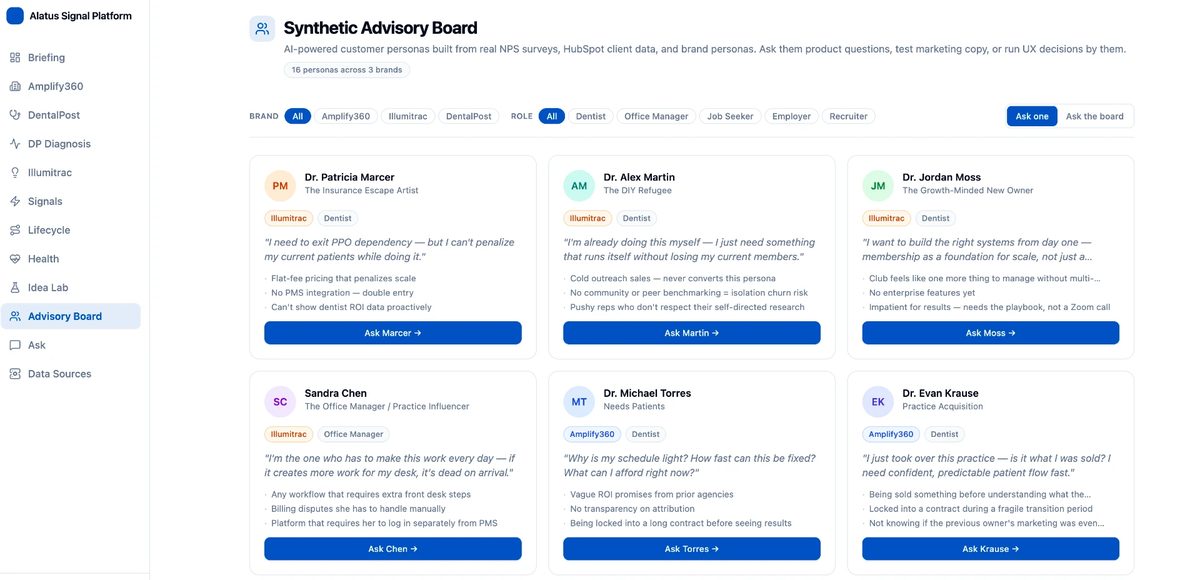
- A Synthetic Advisory Board: 16 AI-powered customer personas across 3 brands, built from real NPS surveys, HubSpot client data and brand personas. We use them to pressure-test product questions, marketing copy and UX decisions.
- Other modules: per-brand views, Lifecycle, Health, Idea Lab, Ask, and Data Sources.
What changed
Status: Working prototype
2 of 3
Targeted brand leaders began using the prototype
Early use, not production scale
More detail
AI approach & safeguards
- Trust depends on data reliability. I treat the prototype's usefulness and production readiness as separate questions.
- A coverage check compares signals against HubSpot lifecycle flags and is explicit that "stalled" may just mean quiet, not unhappy.
- The advisory board personas are synthetic, not real customers. They complement real customer research; they don't replace it.
Tradeoffs
- Speed over robustness: the prototype answers 'is this useful?' quickly but is not production-ready.
- Synthetic personas are fast to consult but can only reflect the data behind them, so real conversations still decide.
Lessons
Early adoption is a signal of usefulness, not proof of financial impact.
Built at Alatus Solutions. Internal architecture, customer data, and confidential business details are intentionally omitted.